

- Features
- Artificial Intelligence
AI Assistant in the Risto Pilot app
Discover how to get support, reporting, and data analysis with the help of artificial intelligence in the Risto Pilot app 🤖📊
If your management system already includes reservation management, customers, orders, tickets, inventory, and shifts... then you already have a treasure.
The problem is always the same: there is no time to extract the data, read it properly, and turn it into useful decisions.
AI Risto Pilot was created for this: ask a question (written or spoken) and the AI assistant queries your restaurant’s data, creating dynamic statistics and reports quickly and in a readable way. The result? Less time spent “working with sheets,” more control.
- ✅ Reports and analysis on customers, reservations, staff, tickets, orders, and inventory
- ✅ Natural language questions (including voice): no formulas, no queries
- ✅ Clear output: trends, period comparisons, anomalies, operational summaries
- ✅ Real data from your management system: “live,” updated reports ready to share
AI in restaurant management: why it pays off when data grows 📈
Every day, a restaurant produces data: accepted and rejected reservations, no-shows, tickets, preparation times, receipts, customer preferences, staff clock-ins, stock, and supplier orders. Over time, these numbers become many... and “too many” to read manually.
That’s where AI comes in: not to replace the restaurateur’s experience, but to do the heavy lifting in seconds: searching, aggregating, comparing, explaining. And leaving you only the part that matters: deciding what to do tomorrow.
Artificial Intelligence assistants in the Risto Pilot management system
Get reporting, analysis, and suggestions for your restaurant simply through a voice request or a message.
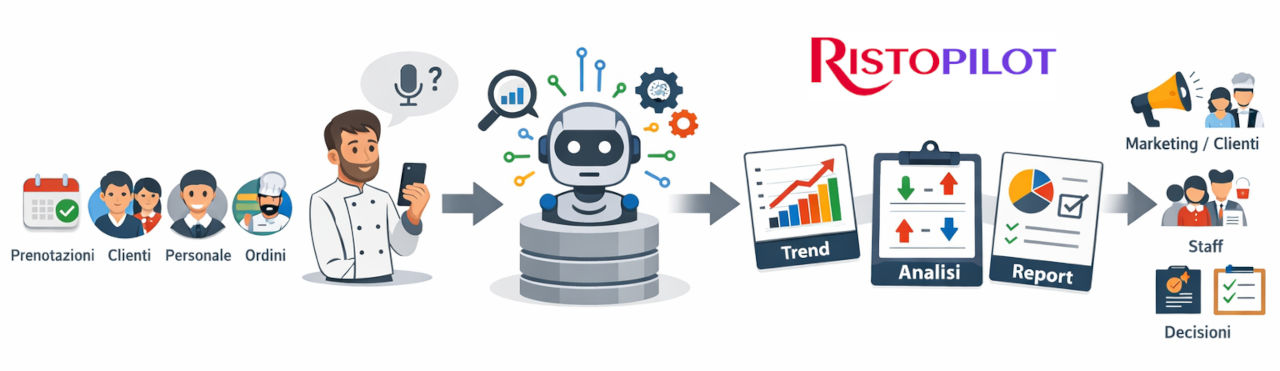
How AI Risto Pilot works (without technical jargon) 🎙️🧠
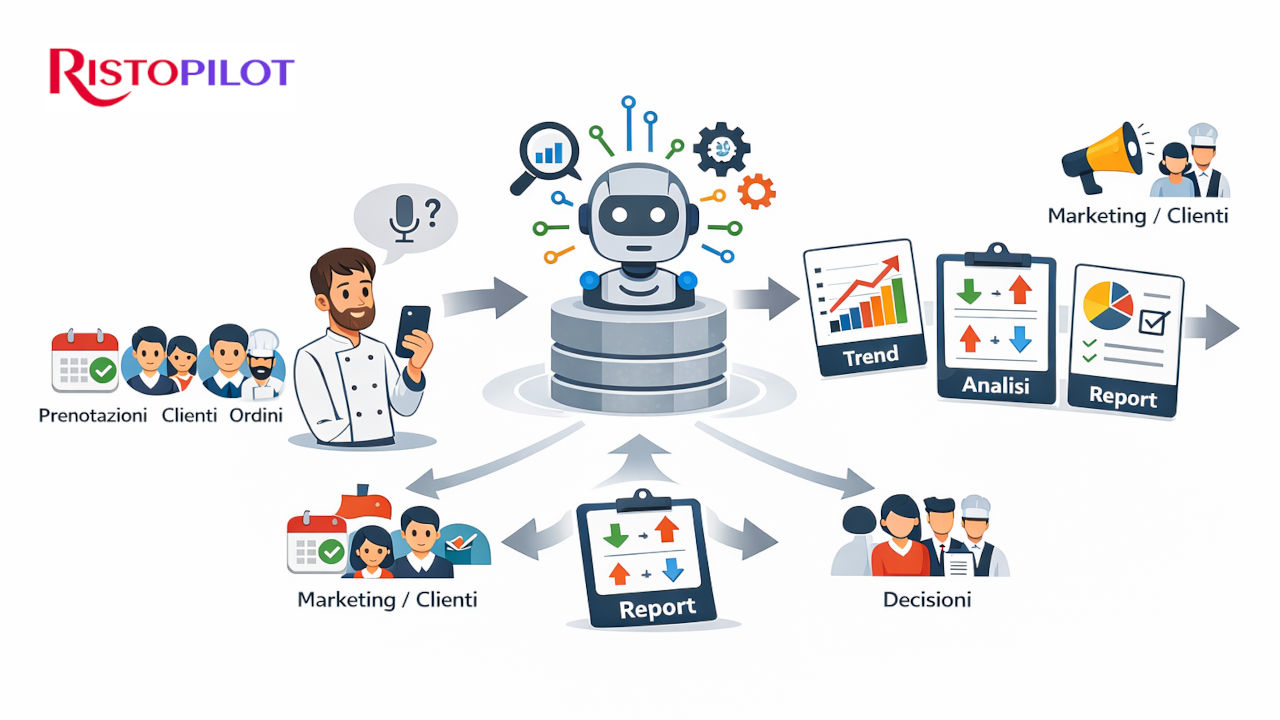
The process is simple, like talking to a super-precise collaborator: you make a request in written or spoken form, the AI assistant interprets the question, queries the databases based on the available data, and returns a readable output.
With the help of AI: dynamic reports based on real choices ✅
We are not talking about “static reports” to download and forget. AI can generate dynamic reports based on your filters and questions: period, department, channel, customer type, dining room, time slot, events, and much more (depending on the data in your management system).
Restaurant management AI assistant: fast answers, well explained (not just numbers) 🧾
In addition to values, the assistant can provide useful interpretations: comparisons between weeks or months, percentage changes, top and bottom performers, unusual signals, and summaries ready to share with partners or managers. In practice: less “data hunting,” more operational clarity.
What AI Risto Pilot can analyze for your restaurant 📊🍽️
Below you will find the main areas the AI assistant can work on. The point is not “having one more chart,” but getting answers that change how you organize service, kitchen, and cashier operations.
Artificial intelligence for restaurant management: reservation analysis 📅
AI can help you read reservation trends by day, time slot, and period, highlighting peaks, drops, and trends. If you use online forms and in-app reservation management, you can request useful summaries on accepted/rejected requests, changes, cancellations, and attendance quality.
Practical goal: understand where you are losing covers, where you have room to grow, and what is really happening on the “odd days.”
Data analysis with the help of AI Risto Pilot: customers and behavior (master data, visits, no-shows, orders) 👥
If your management system has customer records with reservation history, visits, no-shows, and orders (including QR orders), the AI assistant can create reports on frequency, return visits, inactivity periods, anniversaries, and useful segments. Not to “do theory,” but to turn data into operational actions (targeted marketing, no-show policy, dining room management).
Restaurant management AI assistant: staff (clock-ins, shifts, roles, departments) 👩🍳🕒
AI can help you read clock-ins, shifts, and the distribution of duties by department, highlighting coverage, workloads, and recurring patterns. It is useful when you want to answer practical questions like: “where is the real workload concentrated?”, “when is more support needed?”, “how are workloads changing over time?”.
Practical goal: less organizational stress, more balance between service and costs, without losing quality.
Restaurant app with AI: tickets and customer orders (from waiters and from QR) 🧾📲
If tickets are entered in the app by waiters and orders also arrive from QR codes on tables, AI can create reports on quantities, categories, most requested products, time slots, and service dynamics. It is a simple way to understand what is really selling, how the mix changes, and where to intervene on menus and processes.
Artificial intelligence to manage the restaurant: KDS and preparation times (logged steps) 🍕🔥
When tickets and orders are managed through KDS (ticket monitors for the kitchen and other production departments) with tracked preparation steps, AI can help you read average times, bottlenecks, and differences between departments (kitchen, pizzeria, etc.). Everything is “logged” and, if the data is available, you can ask for analyses to understand where service slows down and why.
Practical goal: improve pace, coordination, and perceived quality without disrupting the organization.
Restaurant software with artificial intelligence: analyze cashier operations, payments, and documents (receipts and invoices) 💳🧾
If you use Orders and Cash Register to manage payments (single, split evenly, or divided), receipts, and invoices, AI can create useful summaries on volumes, trends, receipt composition, and recurring requests. And if you also manage invoicing (receipts and invoices with archives and PDFs), you can request organized reports by period or type.Restaurant management AI assistant: inventory, ingredients, and supplier orders 🧂📦
When you manage ingredients, supplier catalogs, and (where available) inventory with Smart Shopping List, the data becomes a goldmine: consumption, turnover, most “sensitive” items, changes over time, and operational checks. AI helps you extract this information without having to open a thousand screens.
Practical goal: less waste and fewer “gut-feeling orders,” with readable numbers in just a few seconds.
Restaurant management software with artificial intelligence: operations and logged activities (customers and operators) 🧠🧩
If the management system records operations (activities performed by customers and operators, with times, activity type, and involved parties), AI can help you reconstruct “what is really happening” in the operational flow: workload peaks, repeated steps, time-consuming activities, and automation opportunities.
Risto Pilot AI assistants in the app
Query the AI about your management system data to obtain information, reports, and immediate analyses useful for making decisions right away.
Restaurant management AI assistant: examples of useful requests (copy & paste) ✍️
Below you will find examples of “restaurateur-style” questions. They are designed to get you an immediate, readable answer. You can ask them exactly as they are, or customize them with period, department, dining room, channel, or time slot.
- “Give me a report of reservations by day and time slot in the last month, compared with the previous month.”
- “What is the no-show rate and how does it vary by day of the week?”
- “Show me the customers who haven’t returned in more than 90 days and how many they are, divided by source.”
- “Which dishes are ordered the most, and how does the mix change between lunch and dinner?”
- “Summary of average preparation times by department (kitchen/pizzeria) over the last 2 weeks.”
- “Shift and clock-in analysis: where is the workload concentrated and on which days is more coverage needed?”
- “Inventory/supplier report: which ingredients move the most and which generate the most waste?”
Related Modules 🔗
The AI Assistant performs at its best when it pulls real data from operational modules: it analyzes, summarizes, finds patterns, and helps you turn numbers and everyday activities into fast (and more profitable) decisions.
Restaurant app with AI: try it now (limited test versions) 🚀
Want to see live how AI can read your restaurant’s data and generate truly useful reports? Test the suite now: available trial versions are limited.
Less time searching for numbers. More time making your venue perform at its best. 🍽️